
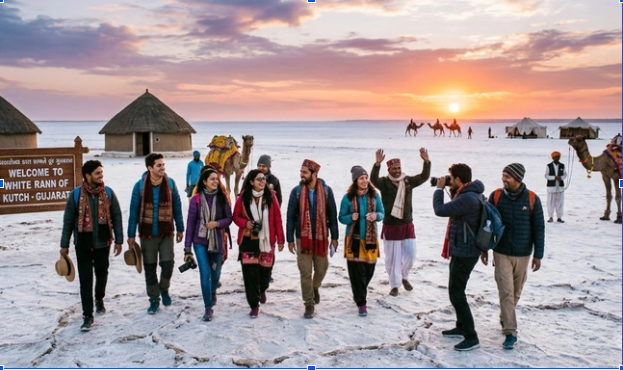

The Great Rann of Kutch is one of those landscapes that demands explanation. Standing on the white salt flats and looking toward a horizon that disappears into a pale, shimmering distance, it is almost impossible to believe that this vast expanse was once the bed of a shallow sea. The story of how this landscape came to be, and how the remarkable culture that grew up around it came to be celebrated through the Festival, is as extraordinary as the place itself.
The Geological Story of the White Desert
The Rann of Kutch is a salt marsh, not a true desert in the conventional sense. For centuries, it sat at the edge of the Arabian Sea, flooded annually during the monsoon and drying out through the winter months to leave a thick crust of salt and mineral deposits across its surface.
How the Landscape Formed
During the monsoon season, the Rann floods to a shallow depth as water drains from the surrounding land. As the dry season sets in and temperatures rise, this water evaporates, leaving behind the brilliant white salt crust that gives the landscape its extraordinary appearance. The Great Rann covers approximately 7,505 square kilometres, making it one of the largest salt marshes in the world.
A 2 Days Kutch Tour Package that includes a walk on the salt flats gives visitors a direct, physical connection to this geological process, the crunch of salt crystals underfoot is the most immediate reminder that you are standing on what was recently a shallow water body.
The Cultural History of Kutch
The landscape shaped the culture as much as the culture shaped the landscape. The Rann created natural barriers that both isolated Kutch from the surrounding regions and made it a unique crossroads for trade between the Indian subcontinent, the Arabian Peninsula, and Central Asia.
Who Settled in Kutch and Why
The various communities that have called Kutch home over the centuries, Rabari herders, Jat pastoralists, Koli fishing communities, and merchant communities from across Gujarat, each brought distinct traditions that mixed and evolved in this remarkable environment.
The 2 Days Kutch Tour Package visitor who spends time at the festival will encounter the living outcomes of this history, embroidery traditions from the Sindh region, musical influences from across the Arabian Sea, and craft techniques that reflect trade connections stretching back over a thousand years.
How the Rann of Kutch Festival Came to Be
The Rann Utsav, as the Rann of Kutch Festival is formally known, began as an initiative to promote tourism in Kutch following the devastating earthquake of 2001 that caused enormous damage to the region’s buildings, economy, and communities.
| Year | Development |
| 2001 | Earthquake devastates much of Kutch; recovery and rebuilding begin |
| 2005 | First Rann Utsav held to promote tourism and support artisan communities |
| Subsequent years | Festival grows in scale and reputation, attracting visitors from across India and internationally |
| Present day | One of India’s most celebrated cultural festivals, running from November to February |
The festival was deliberately designed to do several things simultaneously, celebrate the extraordinary natural landscape, showcase the living craft and cultural traditions of the region, and provide an economic platform for the artisan communities whose livelihoods had been disrupted by the earthquake.
What the Festival Celebrates and Why It Matters
The Rann of Kutch Festival is not simply a tourism event dressed up as culture. At its heart, it is a genuine celebration of what makes Kutch extraordinary, the landscape, the communities, and the traditions that have evolved here over centuries.
The Elements That Give the Festival Meaning
- The white desert itself: making it accessible and celebrated, rather than simply a remote natural feature, connects visitors to a landscape of genuine world significance
- Living craft traditions: by providing a platform for artisans to present their work to a wide audience, the festival contributes directly to the economic survival of techniques that might otherwise fade
- Folk performance: the music, dance, and storytelling traditions on display are not revived historical performances but living traditions still practised in communities across the district
- Seasonal timing: the festival’s alignment with the winter months and the full moon cycle connects it to the natural rhythms of the desert itself
The Landscape in Different Lights and Seasons
The white desert looks different at every hour of the day and every point in the lunar cycle. During the festival season:
- At noon, the salt reflects the sky and creates a blinding, almost featureless white expanse
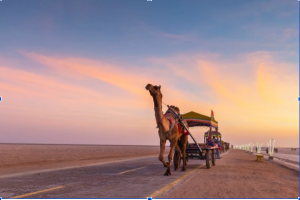
- At sunset, horizontal light turns the crust gold and throws long shadows that give texture to what appeared flat at midday
- At the full moon, the reflection of moonlight on the salt creates a ghostly luminosity that photographers and poets have struggled equally to describe adequately
Conclusion
The story of the white desert and the festival is ultimately a story about a landscape so extraordinary that it shaped everything around it, the communities who settled near it, the cultures they developed, and the celebration that grew up to honour all of it. A 2-day Kutch Tour Package barely scratches the surface of this story, but it is enough to understand why this place stays with visitors long after they have returned home. Rann of Kutch Festival connects visitors to this story through experiences designed to reveal its depth, turning a visit to a remarkable landscape into an encounter with something genuinely profound.